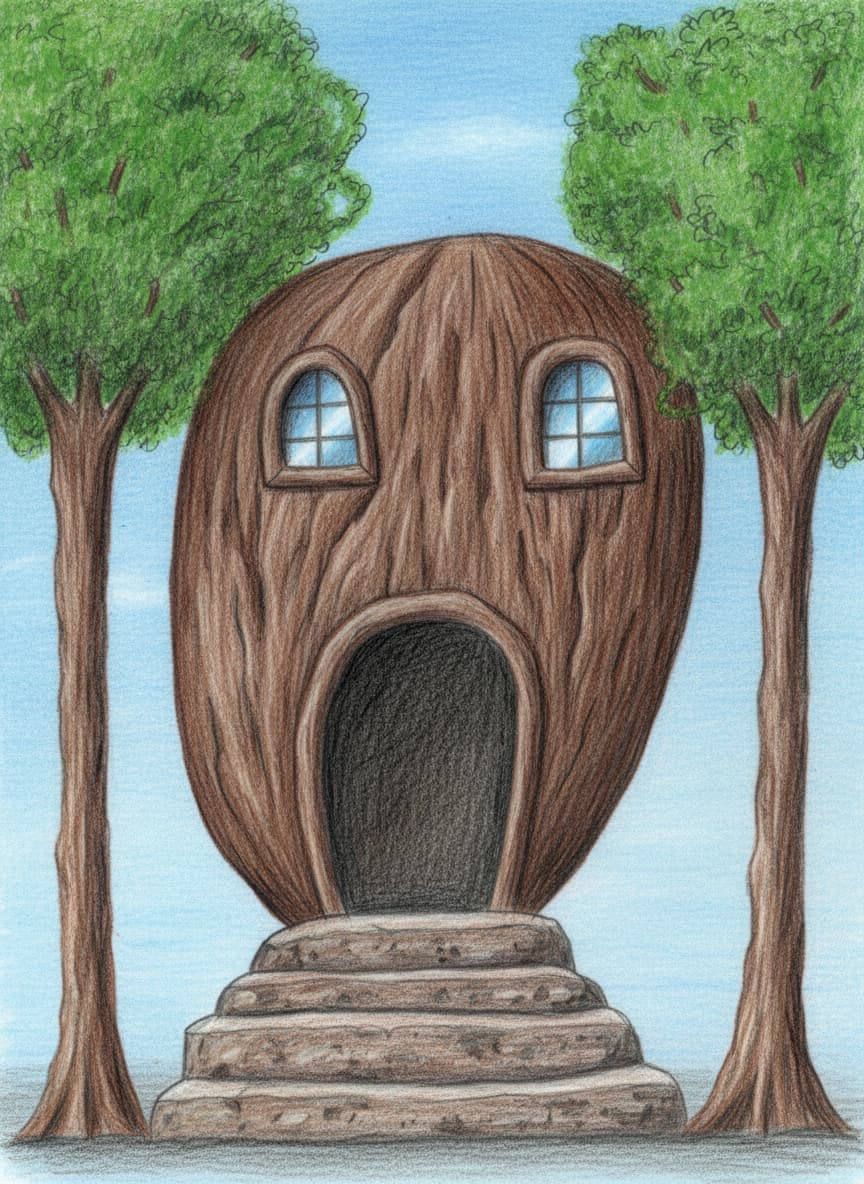
This was me as a 100% beginner on Photoshop

There are a lot of threats to the industry … AI, cheap stock art, templates, cheap/free software, a “good enough is good enough” mentality, crowdsourcing/contest sites, people willing to work for pennies on the dollar just for the experience, a glut of applicants for every one open position. Bottom line, there are more and more designers competing for a piece of a shrinking pie. I don’t think the demand for skilled and qualified designers will go away completely. But you need to put in the work so that you will rise head and shoulders above the pack.

I don’t know you, don’t know where you are in your education or journey, don’t know how good your work is, but, if it’s not too late, I would suggest you find out what the job market is like for designers in your area and, if necessary, consider a career shift. I have three kids that are all young adults, and I am glad none of them decided to follow in my footsteps.

I’m certain that will happen and already is happening. However, I’ve seen three major upheavals in graphic design during my career: AI, the internet, and desktop publishing. Instead of viewing them as catastrophes that would leave me in the dust, I’ve seen them as opportunities to get in on the ground floor of something new.

Marketing firms are already laying off junior staff who have traditionally handled the boring, basic tasks. Just for fun, I wanted to see what Anthropic’s Claude could do when asked to develop a marketing plan. I made up a company: its products, goals, size, challenges, competitors, target audiences, financial resources, and so on. I gave Claude all the information. It asked me for some additional information and, within seconds, gave me a realistic plan framework. It’s a little bit scary.

On the other hand…

Clients don’t know anything about design, even though many of them think they do. For example, I can’t count how many times a client has asked me to design a brochure. They could ask the same question of AI, or an AI-enabled platform (like Canva), and it might give them something they like. However, what clients like and think they need rarely matches what they actually need.

When a new client has approached me about needing a brochure, I’ve typically asked them why they need one. Half the time, the answer is good. For example, “we have a tradeshow coming up, and last year we handed out 10,000 brochures.” The other half of the time, they’ll come up with a shallow, thoughtless answer, such as they have a new product. When I ask them how they plan on distributing 50,000 brochures, they typically have no clue; they’ve never thought it through. I might end up talking them out of the brochure they think they wanted and convincing them that investing the same amount in highly targeted social media ads will produce better results.

That was just one example among hundreds, but my point is that clients using AI to implement their own naive design visions won’t turn out well for them. This won’t stop them, of course, but I’ve never wanted to work with naive clients anyway. Working with the savvy ones who have money and know the value of good design is always preferable.

Similarly, if I need a suit to wear every now and again for funerals or weddings, I can go to a department store and buy one off the rack. It might work fine for what I need. However, if I were a $ 600-per-hour business attorney, I’d probably opt to rely on a tailor who specializes in business suits. It would cost ten times as much as that off-the-rack suit at the department store, but the attorney realizes that he has an image to maintain and that the expensive, bespoke suit is a good investment.

Going forward, I think beginning designers can be bottom-feeders who pick up small jobs here and there on the side, or they can learn to use AI to their advantage and do whatever it takes (talent, education, experience) to aim for the higher-end, savvy clients who know that achieving their goals depends on hiring the right people with the right experience, insight, and intuition to make it happen.

I’ve thought about it, but that would turn something that I do for fun and relaxation into a stressful job. Besides, people are already doing it with AI imagery, and I can’t compete with that — especially considering that AI can pump out hundreds of images in the time it takes me to sharpen a pencil.
:face_with_diagonal_mouth:

I did say in my post that I used to sketch thumbnails but no longer do that step.

1 Like

AI is not perfect and makes more mistakes than Human Designers, everything of AI is a Hype. Just look around you and you will see it is not perfect.

AI is not perfect, but to say it is hype is naive.

Well … it is not a naive, and it is AI hype as many people say

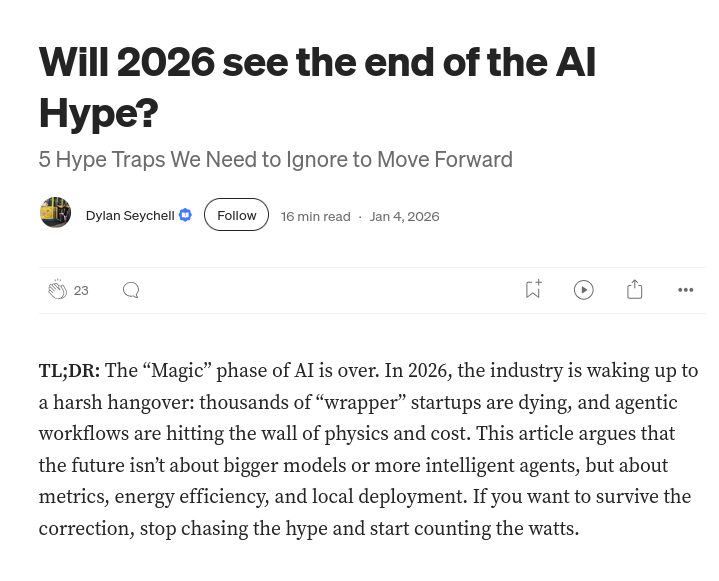
And you can read the article here : https://medium.com/@dylanseychell/sobering-up-about-ai-and-the-shift-from-magic-to-metrics-93d056dbcfe9

Okay, since I don’t think anyone here is running a wrapper company or designing agentic workflows, let’s bring this down to a practical, client-oriented, and day-to-day level.

As a working designer both servicing existing clients and looking for new clients, I can tell you based on first hand experience that clients and would-be clients are looking at AI as an alternative or as a supplement to traditional creative talent. So, no, it is not correct to say “everything of AI is a Hype.”

Designers need to understand how they can use AI as a creative tool and as a business tool. They also need to understand AI from a client’s perspective and, even more so, be prepared to offer a defense for human talent.

1 Like

I think that if clients rely only on AI, they might overlook mistakes. AI can generate content quickly, but it sometimes makes errors or produces things that don’t fully make sense. You still need a human designer to check, refine, and make sure the work is accurate and gives the right message. So I think AI can help, but it shouldn’t replace humans. Perhaps designers should start to think of AI as another tool, not an replacement.
Also, this website has some interesting information on what clients think about AI:

1 Like

Society sometimes gets ahead of itself when anticipating huge changes whose effects require more time to mature and play out. This happened in the late 1990s, during the dot-com bubble, which burst in 2000. It might be happening again with artificial intelligence.

However, the dot-com bubble did not mean that the internet was a hype. Instead, the collapse was evidence that investors misjudged the immediacy of the internet’s effects.

I think much the same is true of artificial intelligence; it won’t change everyone’s lives overnight, but over the next few years, its effects will be staggering as it continues to improve and corporations devise ways to use it.

I could be wrong, but within 5–10 years, I suspect the field of graphic design will be almost unrecognizable from what it is today and will require fewer designers. I don’t see graphic design as a growth profession moving forward, but it should be interesting.

1 Like

For fun I put it into AI Firefly just with prompt make into realistic drawing

3 Likes

Wow :astonished:
Sadly I can’t use AI. But I must say it did a pretty good job.

Hi Han1, why you say you can’t use AI?, then you are just blocking yourself to get a job… right now learning about AI, it is a requirement for everybody even Graphic Designers should learn it because you may find that there are jobs requiring people to use AI in the Graphic Design field.

Speaking about Graphic Design and AI, the only thing I don’t see is an AI Tool making graphic design, creativity and other things by themselves, when they already need instructions by command prompt what people wants to do with them (AI). When I speak “Ai is a hype” what I mean some people is making some over exaggeration about what AI can do and what AI cannot do. For example some Ceos says that “AI will replace these jobs and these jobs” I mean …even I have been spoken with some AI tools to resolve some issues, and they just make a mess. One useful example of the mess done by AI is this one : Neocities founder stuck in chatbot hell after Bing blocked 1.5 million sites - Ars Technica and there are more example like the Amazon AI tool : “Amazon’s AI tools caused a 13-hour long disruption after its Kiro AI deleted and recreated an environment”. So for me some people have been overexaggerated the use of AI. I think AI still is useful in some way, but some people are still exaggerating the use of AI. Even ChatGPT could not win a match on chess to an Atari 1979, I mean what can you expect from AI?

Wow. This is truly an impressive drawing. I sincerely appreciate you sharing your insights, and I will certainly keep in mind everyone’s insightful suggestions ( even though it wasn’t directed towards me :grin: ). I am still developing my drawing skills, but I am eager to continue learning. May I ask if you created this from memory or used a visual reference?

2 Likes

The pears? Thank you. It wasn’t finished, but I was just working on it when I checked in on the forum. We have a couple of pear trees in our yard, so I took some photos last summer. The drawing is a combination of bits and pieces and some artistic license.

2 Likes

Sorry, I meant for my studies, I’m not allowed to use AI to polish or improve my work. For that sketch it’s fine, though. I’ve used AI for generating images plenty of times; I’m just not allowed to use it for the work my course gives me.

1 Like

AI will always need someone giving it instructions on what’s needed (a brief). Every tool ever made needs someone who knows how to use and direct it.

I looked it up, and it’s already replacing people at a pretty fast rate. AI currently handles about 95% of call center inquiries (as bothersome as they are). AI is rapidly reducing the need for programmers. For example, the code behind Anthropic’s Claude LLM was almost entirely written by AI based on instructions it was given. AI tools now handle around 39% of document review tasks in large law firms (The need for paralegals is shrinking). Routine bookkeeping and data entry roles are disappearing as AI automates invoice processing and tax preparation. Inventory management and cashier jobs at retail stores are being replaced by AI. The list goes on and on.

Those are almost certainly examples of errors that originated with the humans who were involved. Any errors or flaws in the AI (hallucinations, for example) are solvable algorithmic glitches that say little about the technology’s overall trajectory.

I think you’re underestimating its potential. It could easily be the most consequential invention in human history. It’s already almost to the point where it can identify its own inadequacies and rewrite its code to solve them. Think for a second what that means — a computer program that has instant access to all the world’s collective knowledge that can use everything it knows to make itself more powerful and efficient, at which time the improved version of itself can make an even better version, which in turn can do the same over and over.

The predecessors of present-day AI mastered chess back in the 1990s. A human grandmaster chess player cannot win when playing against them. ChatGPT losing at chess is a quirk of how large language models work; they’re not designed to play chess through massive calculations; they’re language predictors trained on datasets.

1 Like

So I guess saying "everything of AI is a Hype” is not accurate?

I mean both of them (Ai is a Hype, and it is a requirement), as I said before AI is useful in some task but not useful for everything. One example is Generative AI is useful in some way, and it is a hype because many people only think that only prompting commands to an AI tool they don’t need Video editors or 3d tools when we know that Generative AI make some videos with defects and not perfect (there are so many examples out here). This is an example of a hype : “Don’t use Photoshop or any other paint program to modify your images because Generative AI can do everything!”, I mean some people are overexaggerating the use of AI. I am not against AI and I think it makes great things but as I said before some people (some CEOs and some people) are overexaggerating the use of AI.