Hey everyone! I’m a fourth-year design student developing a card-based toolkit that helps designers spark new ideas and explore creative thinking from different perspectives.
I’m running a short survey to learn how people approach design prompts, constraints, and brainstorming. While it’s especially aimed at early-year design students, I’d love to hear from experienced designers as well — your insights will help shape how accessible and useful this toolkit becomes.
It only takes a few minutes, and your answers will directly inform the final design of the cards and workshop format.
I’m sorry, but I got most of the way through the survey before giving up. Your definition of brainstorming seems different from mine. I think of brainstorming as a group of people getting together and tossing around random ideas in the hopes of generating workable ideas. Your questions seem based on a different definition.
You use the term “design prompts” in the survey. What is a design prompt?
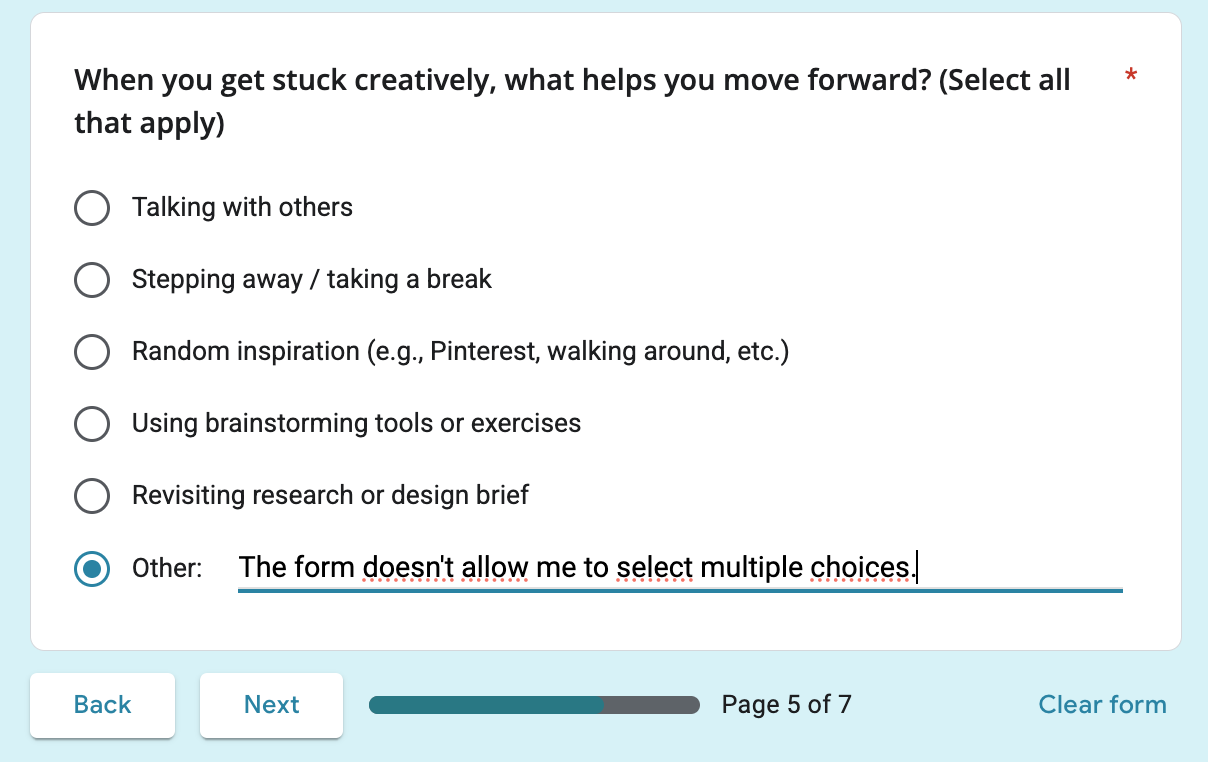
By the way, at least one of the questions (I can’t remember which) permits multiple answers, yet the survey form uses radio buttons that do not allow this. You need checkboxes to enable multiple answers.
Have you come across Brian Eno and Peter Schmidt’s ‘Oblique Strategies?’ this was a 1975 creative ideation aid - mostly for music but might be worth investigating
Hi! Thank you for taking a look at the survey. Could you describe what you found confusing? There is no actual definition of brainstorming listed in the survey, so it is up to the individual’s interpretations. Although we as designers do work well in groups, there are instances where we do need to work alone or map out our process. This is what is meant by brainstorming, or, to be more exact, the way you approach your design process!
Additionally, I did check the survey. There are no questions that had bullets where checkpoints were needed, but I changed some of them anyways.
For what it’s worth (on the off chance you’re unfamiliar with the specs), radio buttons are for a single, mutually exclusive choice, while checkboxes allow for multiple independent selections within the group. This is a WHATWG and W3C HTML specification, not a convention. The Google Forms you used to build the survey comply with the W3C specs.
This is a tangent, but here’s a link to a 2012 New York Times article on (group) brainstorming. If anyone is interested and hits their paywall, you can download the PDF.
My first few jobs as a designer were at ad agencies and design studios. I regarded their brainstorming sessions as a waste of time that inevitably produced mediocre ideas.
When I became a creative and marketing director, I eliminated brainstorming sessions as a regular part of the process. This irked some of the aggressive account executives and managers who saw those sessions as opportunities to push their awful ideas onto the more introverted creative team, whose most creative members came up with their best ideas when working alone or in small groups.
I still wanted to hear what the account managers had to say, of course, because they interacted directly with the clients more than I did. I just saw no reason to waste time and money assembling a crowd to listen to them and others throw crap at the wall in the hope that something would stick.
The NY Times article crystallized everything I had ever thought about brainstorming and group thinking.
Good article, in fact I read her book which resonated deeply.
I always regarded these kind of group activities as an obstacle that had to be negotiated in order to get to a good result, in fact the whole process when you’re working in a design agency for a large client feels sometimes like a series of maddeningly arbitrary obstacles.
I read her book too, but the gist of her insight was convincingly spelled out in the article without the need of an entire book.
Yes, clients can be their own worst enemies. Large clients strangle good ideas with bureaucracy and procedure, and smaller clients often get too caught up in their own naive ideas and lack of imagination.
As for group brainstorming, getting the creative team together to discuss thoughtful ideas, sketches, and directions works well after the participants have had a chance to think through the problem on their own. What almost never works is the trendy practice of assembling a team to spew out random words and thoughtless ideas that get written down on a flip pad or whiteboard and subsequently analyzed in the hope that some good ideas magically emerge from the chaos. Inhouse agencies headed by dimwitted project managers seem especially fond of the latter.
A lot of the time large clients will brief that they want a radical overhaul of their branding or packaging or whatever, you’ll do it, they’ll love it and then incrementally they’ll brief amendments that take it back to pretty much where they were in the first place - but it’s understandable how that happens, people’s job security is pretty much based on not taking risks.
Yeah, I always preferred it when I could work up some ideas and present them for discussion rather than try to describe something in the abstract and deal with a barrage of wayward or irrelevant ideas. Usually the best ideas come during, or immediately after being briefed - and then it seems pointless to performatively and retroactively elucidate some kind of design process.
In the initial meeting, they will say, “We love your work. Everything your team has done fits exactly with what we want to do. Our old look is dated and a bit boring. We need to look different because we’re expanding into new areas. We need something more contemporary, exciting, and with shelf appeal, similar to what you did for UVW or XYZ companies.”
At the second meeting, we show them what we’ve done and expect they’ll love it. Wrong! They say, “I don’t know, it might be too bold. Our packaging has always been a grayish blue, and we’d like to keep that because it’s more soothing. Can you show us some other ideas?”
Third meeting — we show them three grayish-blue ideas. “Hmmm, we like the color, but the big starburst on our existing packages really grabs people’s attention. It’s what our customers look for. Can we see some more ideas with a big starburst?”
Fourth meeting, and three more ideas. “Can you please use the same typeface we’ve always used? Our CEO thinks the wording isn’t quite right. Here are some idea he wrote up with more information.”
Fifth meeting. “It’s almost there, but it’s a little bit cluttered. We wanted it to pop off the shelves. By the way, how much are all these revisions costing us?” We answer, “Well, at $XXX per hour, we’re well over $XXXXX by now.” They say, “What? You’ve got to be kidding. You haven’t given us what we wanted, and you’re still charging us. We’re going broke with all these new ideas that aren’t working for us.”
Several months later, we see their new packaging that they did in-house. It looks exactly like what they told us they didn’t want: boring, no shelf appeal, and a look that’s just a juggled-around and confusing version of what they already had, only more so.