I wonder why developers are pivoting ideals

:police_car_light: A growing trend in creative & dev tooling is quietly undermining the very spirit of creation: “Profit-based pricing.”

Imagine this:
You buy Photoshop, not to hang art on your wall, but to design a flyer for a local business and get paid. Adobe doesn’t charge you extra because that flyer lands you a client. They sell you a tool. You decide how, and whether to monetize what you make with it.

But now? Some new tools are structured like this:
:white_check_mark: You can design websites unless you plan to sell them.
:white_check_mark: You can use the tool freely unless your output generates revenue.
:cross_mark: So if you’re a freelancer, agency, or indie dev? You’re forced into a “commercial license” not for more features, not for support, not for scale… but simply because you intend to earn money from your own work.

That’s not licensing.
That’s rent-seeking on creativity.

It implies:
:small_blue_diamond: Your labor isn’t yours to monetize freely.
:small_blue_diamond: Your skill, time, and vision are secondary to the toolmaker’s revenue model.
:small_blue_diamond: The tool isn’t enabling your business it’s owning a share of it, by gatekeeping your right to sell.

We didn’t sign up for software feudalism.
We signed up for tools that empower, not tools that audit our invoices!

Tools should amplify your value. Not tax it before it’s even earned.

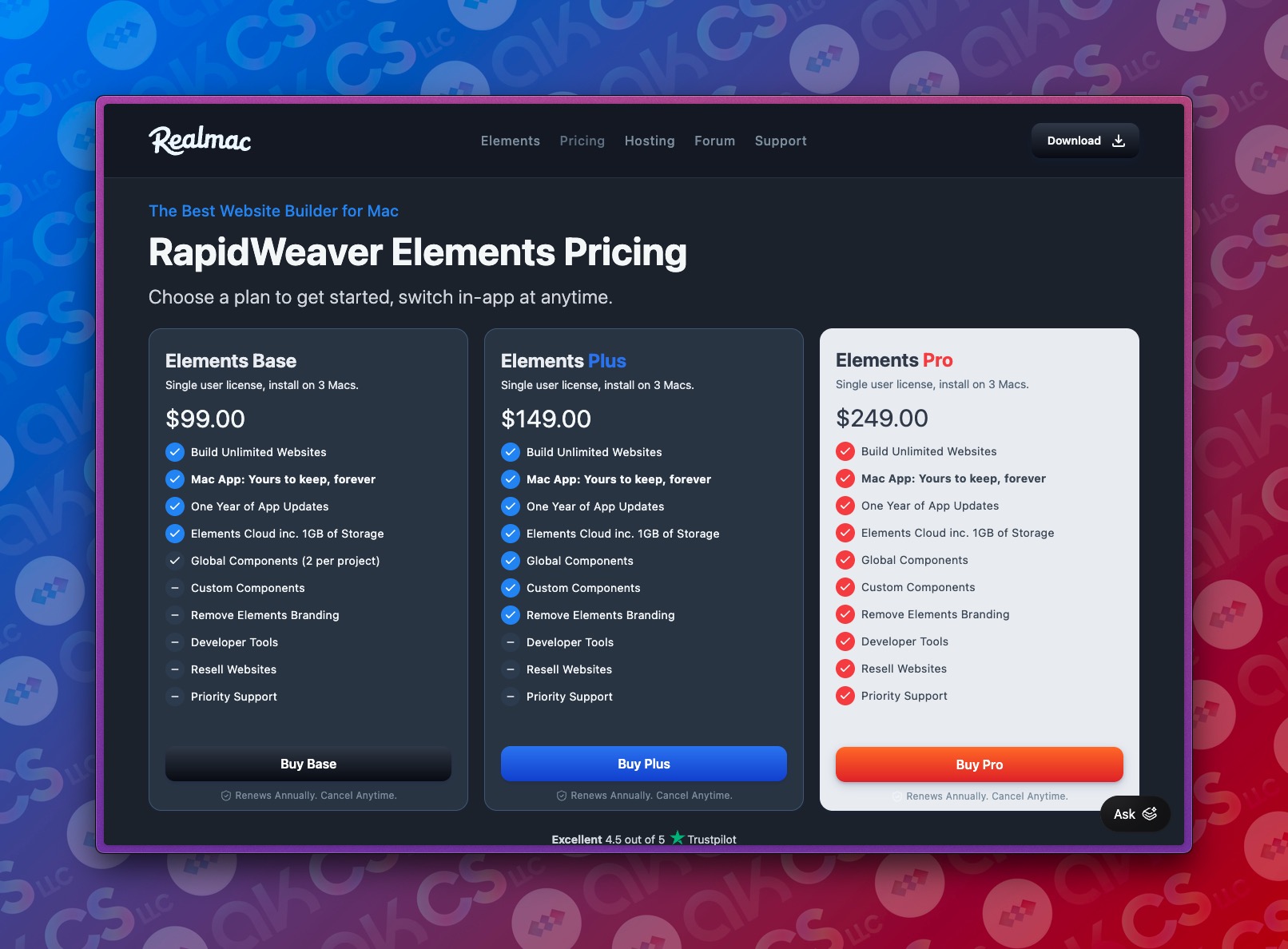
Check out this example with Rapidweaver: if you want to sell your website designs, you need to upgrade to the Pro version! As if $99 was affordable for a single user looking to create their own website! Plus, you CAN’T EVEN REMOVE THE WATERMARK! Are you kidding me?! Are people losing their minds?

:index_pointing_up:I used Linguix AI to fix grammar and spelling

1 Like

Figure out if it is worth it to you as a Pro Tool. Or buy something else.

I’m not sure why anyone would consider the non-pro tool anyway, or why it’s even offered.
$249 per year is about what I pay for good work boots.
Nothing to get angry about. Use it. Or don’t.

For years I had Adobe on my case because we had 3 seats as individuals, not a business license. We don’t use the software as designers or collaborators, we just open other people’s files and print them. We didn’t need to be paying $25 per month more per seat for all the collaboration bullshit.
Until… we had enough seats (more than 10 now) where the business license actually made sense simply for the dashboard feature. We still don’t use any of the other tools.

1 Like

I have been screaming about this for a very long time now. I don’t even like subscription based software.

I still have, and use, my Adobe CS6 Suite because I will never support subscription based software. I used the CC Suite at my last job, and did some personal work on it, but I’d never pay for it when free alternatives are out there.

Us Old Hippies still believe in that sort of stuff.

1 Like

I get the dislike of subscriptions. I don’t think many people enjoy having yet another monthly bill.

And yes, I’d prefer perpetual licences too. Although even then, let’s be honest, you never really “own” software in the way people talk about it. You licence it. But I do understand why people preferred paying once and keeping a version for years.

Where I think the argument falls apart is when people treat “subscription bad” as if that automatically makes Adobe poor value in a professional setting.

I was asked this in work before. Someone said the Adobe subscription model was a rip-off, so I asked how much it cost. Roughly €60 a month. Then I asked how much we charge for one artwork iteration. About €30.

So two iterations pays for a full month of Adobe apps. Not just InDesign. Not just Photoshop. The full suite. Current, supported, compatible, and kept up to date. Including Acrobat (which a reliable PDF reader doesn’t come with other software packages).

And that’s before you even look at actual production output. If an artworker is completing roughly 4–6 jobs a day, that’s maybe 20–24 jobs a week, or 80–96 jobs a month. Out of all that work, only two non-proof 1 (iteration) jobs need to cover the monthly software cost.

At that point, the Adobe subscription is not really the expensive part of the workflow.

The expensive part is lost time. Broken compatibility. Failed exports. Bad PDFs. Missing fonts. Unsupported software. Rebuilding files. Colour issues. Preflight problems. Accessibility issues. Packaging problems. Scripting limitations. Plugins not working. Or a workflow that doesn’t match what clients, printers, agencies, suppliers, and production departments are using further down the line.

That is where the real cost is.

For an old hippee, or a hobbyist, student, retiree, or someone doing the odd personal job, I completely understand why €60 a month feels like too much. Use CS6, Affinity, Scribus, Inkscape, GIMP, Quark, or whatever works for you. Absolutely nothing wrong with that.

If you are not getting paid from the software, or if you are working entirely in your own bubble, then use whatever suits your needs and your budget, who wouldn’t, it makes sense, right?

But in professional design, artwork, production, packaging, print, or agency workflows, the software cost is a business cost. It is not a moral failing. If the tool saves hours, avoids errors, opens client files cleanly, supports current PDF/export requirements, handles fonts properly, fits into the wider pipeline, and helps you get paid work out the door, then it can pay for itself very quickly.

That’s why the “I still use CS6 and free alternatives exist” argument only goes so far.

It works if your needs haven’t moved on, your operating system still supports it, your clients don’t need current file compatibility, and you’re not part of a production chain where colour management, PDF standards, accessibility, preflight, fonts, packaging, scripting, plugins, collaboration, and handoff all matter.

But pretending CS6 is still a realistic answer for every designer in 2026 is a bit like saying you still drive a 1998 van, therefore nobody needs a modern van. Great if it still works for you. That doesn’t mean it works for everyone else. And how much longer will it work, OS modernises, the software stops working at some point.

And then the point always comes to ‘how much did you pay for your computer?’ - a lot of people go out and buy shiny new Macs with a price tag of about €3k+ and then complain about Adobe… Apple are the biggest rip-offs, you can buy a Windows PC that does the same job and spec as Mac for half-the-price - yet you say that to some designers and it’s like ‘blasphemy’ - how dare you not use a Mac for design??? But don’t want to sully my point 3k for a laptop, another 1k on a monitor from Apple, a Magic Mouse, a Magic Keyboard, all pointless and a setup of 5k+ and then moan about Adobe costing 60 quid a month.

Back on track - the same applies to non-Adobe software. Affinity, Scribus, Inkscape, GIMP, Quark plenty of people use them and do just fine. But depending on the job, the problems may not show up at the start. They may show up later when you need to send files back to a client, hand them to another designer, supply print-ready artwork, match an existing workflow, use a plugin, run scripts, package fonts and links, or deal a print/production line who expect Adobe files.

So the better argument is not “subscription bad, free software good.”

The better question is: does the tool justify its cost for the work being done?

Sometimes the answer is no. For some people, Adobe genuinely is overkill. That’s absolutely fine.

But for a lot of professional Adobe users, the answer is still yes. And honestly, €60 a month for the full suite is not the thing that’s killing a professional workflow. I’ve spent more than that on coffees on the road, more than that on diesel when I had a diesel car, and more than that on lunches out.

So no, subscriptions are not automatically evil. And no, Adobe is not automatically a rip-off just because it’s monthly/yearly.

If it isn’t earning its keep, don’t pay for it. That goes for everything in life.

But if it is making money every working day, fitting into the pipeline, avoiding errors, and keeping professional work moving, then it is doing exactly what a business tool is supposed to do.


end rant

2 Likes

As you pointed out, it’s not for everyone. In my case, the budget simply wont allow it. I do think they are evil for not allowing an obscenely overpriced Lifetime License just to shut up people like me who refuse all subscription based software.

Sure, older computers still work and I still have an old one specifically for my Secret Weapon programs like the Original Wondertouch Particle Illusion (FAR superior interface to BorisFX’s interface!!) and an old version of Reallusion’s Crazy Talk (again, the older versions have MORE options!) (WHY do they remove good features and call it an upgrade?).

I am a one Hippy show, so I never need to worry about source file compatibility or team workflows. I do all the Art, Coding, Media Editing and putting it all together on a website. Thus my CS6 is never an issue. I can even render video at 1080p in CS6 and upscale to 4K very nicely on the new ‘puter with other software.

My clientele never want source material either, but I have a rather unique clientele. Being self taught I can’t get a “real” job doing this stuff. Nobody will hire me as part of a team without that dang piece of paper that says I can do what I already can do (or figure out the missing knowledge). Our society is obsessed on those pieces of paper and I am not paper trained!

As a result the only people who will hire me are churches and porn sites. What a resume! I think it’s a wonderful resume because it shows I can work with anybody (I happen to be an Atheist, but back in 2014 I made one of the biggest bible study sites on the web using only media editors, Notepad and Filezilla!).

If adobe want to cater exclusively to big teams, that’s their right. But it IS evil! And I will never support it. It’s that whole capitalism is evil rant again. Screw the little guy if the rich and powerful can get richer and more powerful.

Offer BOTH options.

Finally, I know game developers who lost the ability to finish projects when adobe removed access to older versions of certain CC programs. Again - WHY? People pay good money for 3rd party plugins that stop working on newer versions - which is normal. But all they need to do is just use older software and everything is fine. But the gods at adobe think it somehow hurts THEM if we use older versions of their software.

It’s corporate greed and no other explanation exists.

I’d rather see a more equitable system, but these business models serve nobody but CEOs.

I’ll never stop ranting!

That’s fair, and I think your setup is exactly where CS6 or older software still makes sense.

At some point your setup will fail, not because of Adobe, not because of OS, but time will eventually make your files obsolete and difficult to open, CS6 will eventually stop working.

If you’re a one-person operation, not handing live source files around, not working inside a team pipeline, and your clients only need the finished result, then compatibility is far less of an issue. In that situation, if CS6 does what you need, then it does what you need.

I also agree that losing access to older versions can be a real problem, especially where someone has paid for plugins or has old projects that depend on a specific version. I don’t think “newer” automatically means “better”, and I’ve seen plenty of software remove useful features and call it progress.

Where I’d separate the argument is between “this doesn’t suit my workflow or budget” and “this is a rip-off for everyone.”

For your kind of work, the subscription may not be worth it. Completely fair.

For a studio, agency, artwork department, print production setup, or anyone dealing with client-supplied Adobe files and wider handoff, the calculation is different. Then it’s not just about making the artwork; it’s about keeping the whole pipeline moving without compatibility issues, delays, or rework.

So yes, I’d prefer both options too. A perpetual licence, even an expensive one, would shut down a lot of this argument.

But the reasons why perpetual licenses were discontinued is piracy, and people buying once and not buying again, people had, CS1, CS2, CS3, CS4, CS5, CS5.5, CS6, CCv1-to whatever we’re on now.

At some point support has to end for older models, so Adobe made the decision to subscription to try end piracy, and also, so they 8-20+ versions to keep up to date and working across Windows and Mac operating systems over 20 years of updates.

It makes sense they streamline to current OS and a couple of versions available to download, I still have 2021, 2022, 2023, 2024 and now I have 2025, and waiting for bugs in 2026 to be ironed out won’t move to that til next year anyway.

If I remove 2021-2024 I have no way to get them back. And I still need an active subscription to use them.

But as it stands, I don’t think Adobe is automatically poor value. I think it depends entirely on the work being done. For your self-contained setup, no, it may not be worth it. For a professional production environment, it often pays for itself very quickly.

To keep it brief, I’ll just reply to the core issue: They can discontinue support for old versions but still allow access. There is NO logical reason (other than capitalism and the associated greed) for that kind of crap.

1 Like

I get why developers do it, especially smaller teams trying to survive, but I’ve never been a fan of revenue-based licensing. I’d much rather pay a higher upfront price or a subscription than have to worry about whether I’m “allowed” to make money with something I created using the tool.

1 Like

The necessity to pay or your willingness to pay simply to open and print a file says a lot about this new era. There are open-source alternatives available for opening Adobe files and other formats for printing. However, for some individuals, money isn’t the main issue. I know people who pay $55 a month to Adobe just to have the capability to open a file, and it disgusts me. I’m not referring to you—you’ve already made your point. My concern is for those who waste money just for the sake of it.

1 Like

AMEN, my friend.

1 Like

That’s exactly what it is.

1 Like

That’s not true. I run an agency, so I’ll keep it simple and avoid writing too much. Before the subscription model, I was able to invest $5,000 every four years in new equipment and materials, including software, servers, and asset libraries. After the subscription change, I ended up paying $7,000 annually. Even with the increase in profit, it doesn’t justify these costs. I’m sorry, but that’s the truth.

1 Like

Fair enough, and I’m not going to argue with your own figures. If your software and production costs went from $5,000 every four years to $7,000 a year, that’s a serious increase.

I suppose the way I look at it is that those costs still have to go somewhere.

For example, Adobe Creative Cloud Pro is around $70 a month for an individual plan, and team plans can be closer to $100 per user per month depending on the plan. So for a small agency with several seats, plus fonts, stock, plugins, hosting, backup, asset libraries and other tools, I can see how the yearly figure climbs very quickly. Adobe’s current US Creative Cloud Pro individual plan is listed at $69.99/month, and reporting around Adobe’s 2025 pricing changes put contracted teams pricing at around $99.99/month per user.

But my point is that if those tools are part of producing paid work, then the cost has to be built into the job somehow. It doesn’t need to appear as a separate line item on the invoice, but it should be silently rounded into the pricing.

Even using rough numbers, if a subscription or software cost works out at €92 a week, and you’re doing around 20 billable tasks a week, that’s about €4.60 per task. If you’re spreading it across 920 tasks a year, every extra €920 in software cost is roughly €1 per task.

That doesn’t mean price increases are fine, or that every subscription is justified. They can absolutely become excessive. I just think the cost of the tools has to be treated as part of production, the same way we account for hardware, fonts, storage, insurance, electricity, training, and all the other hidden costs of doing the work.

I’m a vendor, not an agency.
Be disgusted. Not my issue. Not going to argue with your numbers either.

Where I work, we cater to our clients and to other multiple specialty outsources. Adobe is a necessary business expense. It has been forever, in wide format printing. The last thing I want is for a 16ftx100ft print to go toes up in the middle of its run because I didn’t use the software the outsource specs. And I don’t want conversion errors to come out of my pocket if I don’t open a client’s files with the software they use. Do you know how much one of those 16x100 prints costs??? Not out of my pocket, nope. That would pay a year’s worth of several seats for Adobe right there.

Won’t even go into the AI tools that pull fairly accurate bleeds when designers don’t know how to do that (sometimes we need inches of bleed, not 1/8”.)

Use the tools that get the job done and make the money.
That is all that matters.
I like my paycheck.

1 Like

I’m with you on that, PrintDriver!

And RAMEN to you too!

May the blessings of The Flying Spaghetti Monster be with you.

Exactly why everything has a percentage markup.

I’m sure Markup is a dirty word too. :slight_smile:
I mean, why should anyone make any money….

I’ve heard, “If you’re outsourcing, I’m not paying your markup. I’ll do it myself.”
Until they find out how many things can go wrong, and how much it costs when it does….plus how much time it takes to do that – time that could be spent landing new clients or doing real design work….
(Not to mention I get a wholesale discount so they’re really paying about the same price.)

If Adobe suddenly vanished from the Earth tomorrow, after the great cry of woe, we’d pivot to whatever turned out to be the new Industry Standard plus a few outliers. Just like the old days. Quark, Adobe, Macromedia Freehand, CorelDraw, Signlab, FlexiSign…. Had to know em all until they fall by the wayside. Today if I asked a client to supply Quark files, they’d say “WTF is Quark?” But if I had a large enough project coming in, you bet I’d buy a new subscription to Quark if that is what the designer used.

Affinity looked promising for a while. Until, welllll….
Heck, I’ll even take PDFs from Canva, but you get what you get. If it doesn’t rip, you lose your slot and possibly your deadline. We always ask before performing resuscitation on any failed file. We charge $$$ per hour for that (yup, 3-figures)
I’m sure that’s considered Evil too.

But if Adobe did vanish tomorrow, the day after, I’d retire. Good luck with all that. :laughing:

1 Like

I only use Adobe because everyone else does.

If the clients said to move to Affinity, i would. No problem.

My wife has a system for her job I’ve never seen before. She works in a highly regulated area, so the system is complex and hard to work, why wouldn’t it be? Classic case of a horse designed by a committee looks like a camel. Well, I’m always asked to do things for her; she can’t work the system.

But I’m a master button-presser. I press into everything and figure it out.

Same goes for any software put in front of me, and I’ll figure it out.

That’s kinda my job. Figure it out.

Amen, my friend