Oval plinth template convention?

Hi everyone,

I’m working on another part of an exhibition design project and could use some advice from anyone with large-format or exhibition print experience.

The item is an exhibition plinth (600 mm diameter × 900 mm height).

A bit of context, because I know the obvious answer is usually “ask the printer.” I’ve already been back and forth with my client several times regarding the production template, as the first few templates supplied by the vendor turned out to be incorrect. This is now the latest version they’ve provided.

Originally, my client described the plinth as a 600 mm round cylinder. However, while checking the latest template, I noticed the printable width didn’t match the circumference of a 600 mm circle. I translated one of the Chinese layer names and found it contains the word “oval” (椭圆), and my client has since confirmed that the plinth is in fact oval.

The approved artwork has a logo and tagline on both the front and back (180° opposite each other).

If it were a round plinth, I wouldn’t be too concerned because the finished piece could simply be rotated so either side faces the audience, provided the two artwork positions are half the circumference apart. With an oval plinth, though, I’m less certain because there are long and short sides, so I think the orientation matters. As this is my first time working with plinths, I’m unsure whether there’s a standard industry convention.

The template doesn’t indicate:

  • Front or back

  • Seam position

  • Centre line

  • Any artwork alignment reference

It only provides the main print area (1720 × 900 mm) and the total area including bleed (1820 × 1020 mm). There are no panel divisions or additional guides.

So my question is:

When an oval plinth template doesn’t indicate the front, back or seam, is there a common industry convention that the centre of the template represents the front of the plinth, or does the orientation depend entirely on the manufacturer’s production method?

If there isn’t a standard convention, would you avoid making assumptions and insist on a production template that clearly identifies the front or seam before finalising the artwork?

Just to add some context, I don’t communicate directly with the printer—my client does. We have already gone back and forth several times because earlier templates were incorrect, so obtaining further clarification isn’t straightforward. That’s why I’m asking whether there’s a standard industry convention that experienced exhibition printers or designers would normally follow.

Thanks in advance.
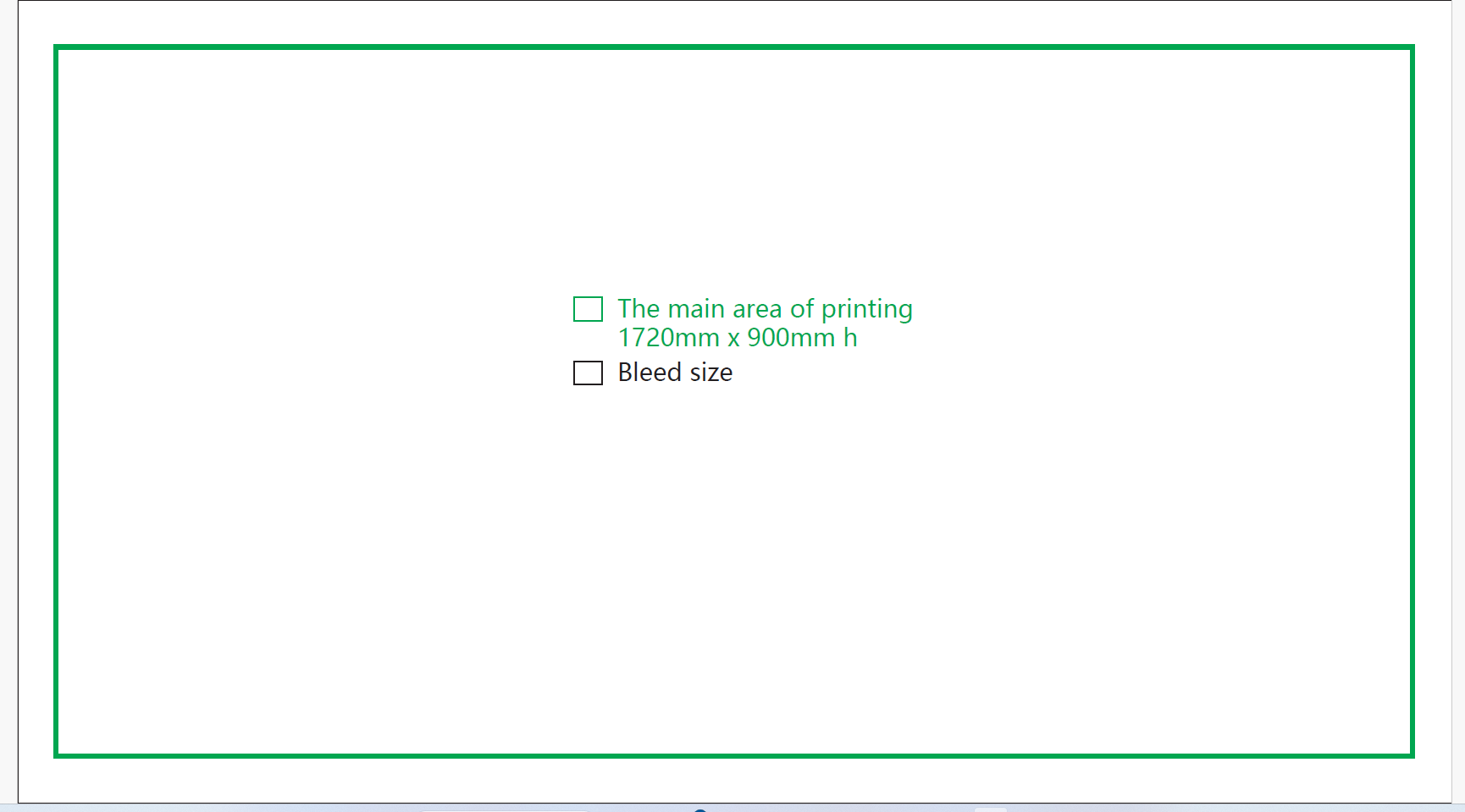
Nothing about 600 on the template.

Template is clear, position it on the template and be done with it. If it’s wrong you have email threads asking, and follow the template.

I usually send the proof, and another file with the template overlayed on it. It shows you did the work and followed the template.

If it’s wrong it’s wrong, that’s on them. Follow the tech spec and you can’t be wrong. The client/printers can be, but you’re following the drawing.

The 1720 mm width can be divided into two 860 mm sections, so placing the two logos 860 mm apart should put them physically opposite one another around the plinth.

However, that only establishes that they are 180 degrees apart around the developed surface. It does not tell you whether they will be centred on the intended front and back faces of the oval. That depends on where the seam is positioned relative to the long and short sides.

The left and right edges of the 1720 mm print area form the join, the centre of the template at 860 mm would be directly opposite the seam. If the manufacturer always positions the seam at the rear, the centre could reasonably represent the front but that is still a production assumption rather than a universal convention.

I would not provide several alternative production files unless the printer specifically requests them, because that introduces another opportunity for the wrong version to be used. I would provide one artwork file and a clearly annotated reference PDF showing

  • the intended front centre line
  • the intended back centre line, 860 mm away
  • the presumed seam position
  • the required orientation of the oval

The printer or manufacturer should then confirm that orientation before production. At minimum, they need to state whether the seam sits at the centre of a long side or a short side.

I would also ask for both finished dimensions of the oval. “600 mm oval” is incomplete because an oval needs a long-axis and short-axis measurement. The 1720 mm developed width may help verify the circumference, but it does not define the oval by itself.

Thanks, Smurf. So there’s no universal industry-standard convention then?

Just to make sure I’ve understood correctly: if the manufacturer defines the front at the centre of the template, then the wrap join would typically end up opposite it, meaning the back artwork could span the join, making it less ideal for important text or logos. But if the join is instead positioned on one of the short sides of the oval, then having text and logos on both the front and back shouldn’t be an issue because they’d both sit on the two main faces of the plinth.

Is that the correct way to think about it?

I have no idea, there’s no universal truth, I’d never send out a template like that. To me it just says the print area and bleed size.

Design into that - then send that along with a mockup of what you think it might look like.

Who knows, seems very open ended.

Thanks, Smurf. I’ve asked the client to clarify it with the printer. If we still can’t get a definitive answer, I’ll follow the supplied template and include a mockup/reference showing my intended orientation so at least everyone can review it before production.

1 Like