Help with what pain points logo design solves

Recently I’ve been trying to reposition myself in the logo design aspect trying to figure out what pain does it solves for clients, but it’s not a widely covered topic, or at least I couldn’t find anything online.

There are two major types of clients: those that don’t want or have any motivation in investing on any kind of branding, and those who are aware of the problem. These are two types of clients that need completely different types of communications, because you can’t sell a solution to someone who doesn’t has a problem. You could point it, but that’s were the different needed communication aspect arises.

Doing some research I’ve found that the need of EXCLUSIVELY a logo arises, thought as how the clients might think, when:

  • They feel they want to legitimize their business, like some sort of either psychological or actual business barrier to overcome to avoid feelings of shame.

  • To be able to show up in an important presentation.

  • To align their graphical symbol/signature to represent the business as it is today.

  • Feelings of competitive disadvantage to a business that invested in their imagery.

  • The are multiple versions of the same logo applied everywhere, giving feelings of chaos.

  • Fusion or merging with another business.

  • Change in reputation maybe?

  • Market expansion to other locations where the current logo might have issues.

  • Changes in the business model like going from petrol to “energy” maybe?

The needs/pains are too many, and they always vary according to the client size as far as I can tell. But you must figure out that pain first, because if a business is having poor sales and you think a logo will solve that issue it’s like a medic prescribing meds for headache when the woman is pregnant. It’s professional negligence.

Here’s where I’m stuck.

I stuck trying to find out a way to discover what pain/problem the client has beyond the initial “symptoms”, but I also need to know what problem do specifically logos solve so I can tell if I’ll work for their problem or not.

I’m not sure if it’s the norm here, but I’ll just leave this as a clarification because people tend to diverge the conversation into “But logos don’t solve bla bla bla, they need a complete branding/strategy” in other forums or subreddits. I’ll ask you to please refrain from diverging into that path unless it adds up to the conversation instead of making it the main focus. Otherwise I’ll consider it off topic.

I didn’t saw the title was incomplete, I can’t edit it now. The rest of it is “…logo design solves?”

Mods could you change it please?

Titles are only allowed to be so long. I tried to shorten it and still keep what you were asking. I’m not sure what "pain points’’ is. Did you mean pin points?

@RedKittieKat Pain Points are just issues that cause you, well, “issues”.

1 Like

Thanks Craig. My brain isn’t braining tonight LOL :wink:

1 Like

“But logos don’t solve bla bla bla, they need a complete branding/strategy”

This is a truth. I’m not sure what your question is.

Logos themselves don’t solve any problem. They are a mark that distinguishes a business from other businesses. But without a marketing and brand strategy behind the logo, it’s useless.

If you “just do logos” you need to expand your own horizons. A company isn’t built on pretty pictures alone.

1 Like

Take them out to lunch and ask them.

1 Like

Why would it be useless without marketing/brand strategy?

What kind of questions should I ask them? To be more hands into and not just stay with surface level information I mean.

Better question, why do you think you can run a business without a branding/marketing strategy. A logo is only one small part of that very important element of a successful business plan.

Because there definitely are businesses that do it.

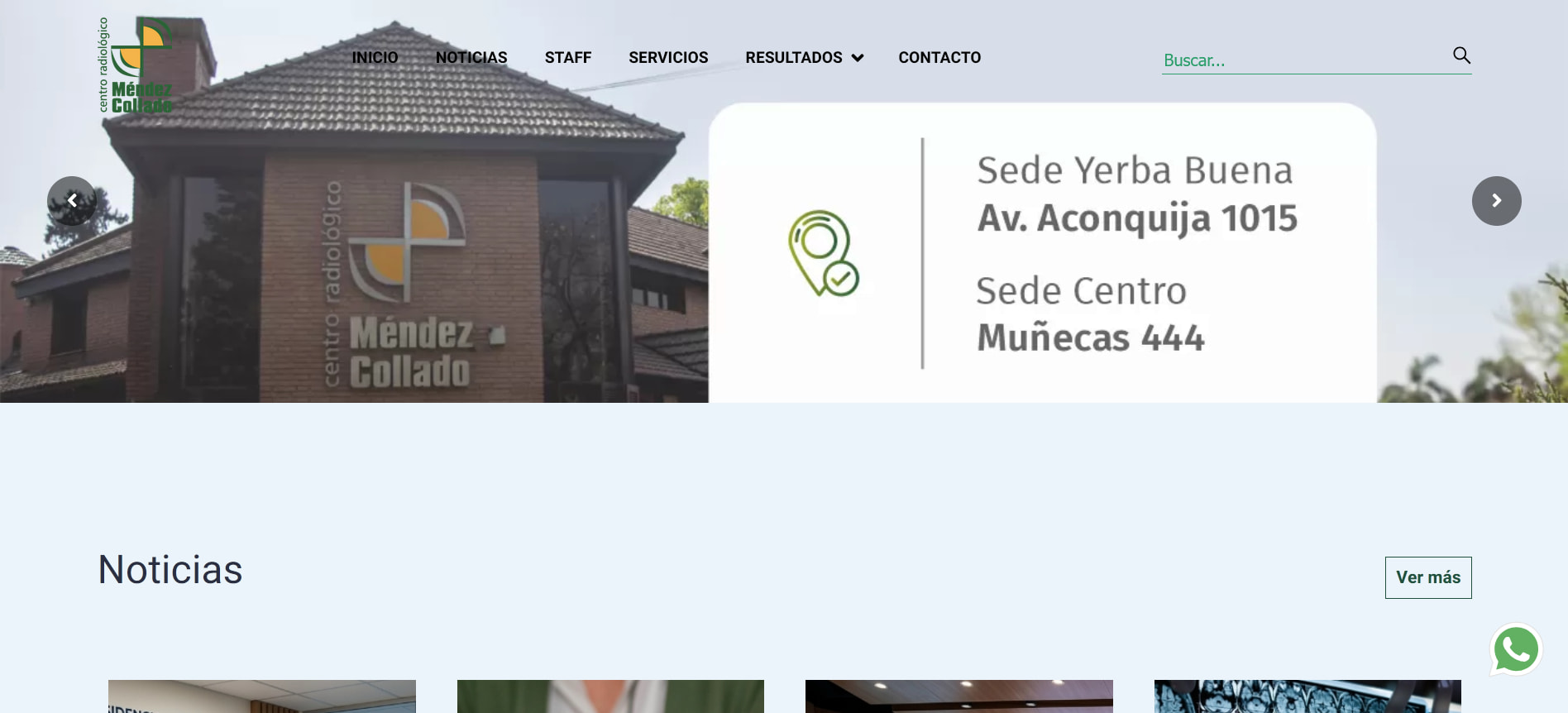
For example: https://mendezcollado.com.ar/

This is a local private radiology center, it’s been around for about probably 30 years. If you visit that website would you say they invested in anything of what we talk about? I doubt so, but they invested in other relevant areas like the infrastructure of their center, in systems to make their processes seamless, in machines that provide good image quality, an easy way to access results codes via Whatsapp and a dedicated website to see them.

I never saw an ad from them, and definitely they are doing good without updating their visual identity since the service is always top notch.

This is one of the cases that make me wonder about my original question. There definitely isn’t a pain/problem for them to redesign their logo. And there definitely isn’t a need in marketing or branding strategy.

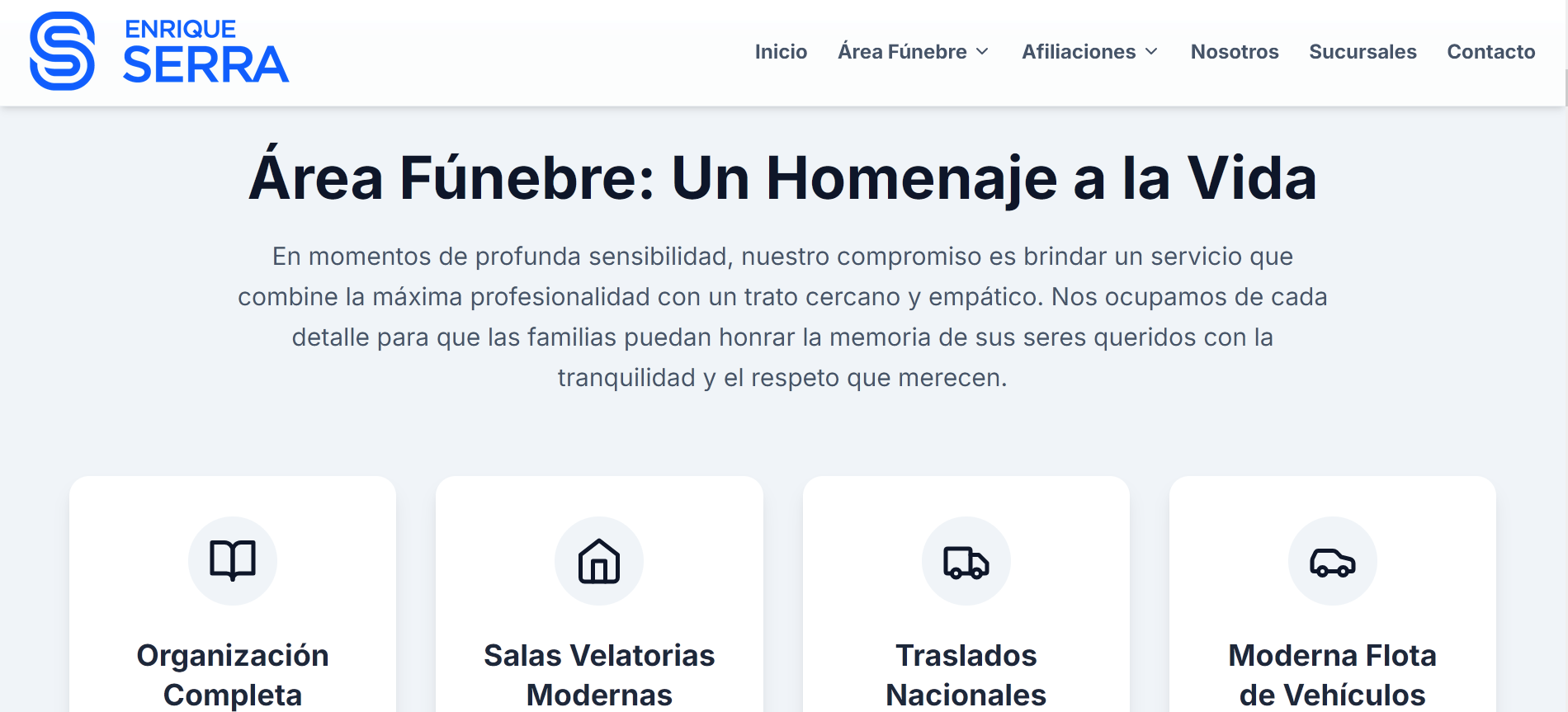
Another example, where a logo designer I really follow created the logo for a local funerary that I cross paths with all the time, and I see their logo in a big bright signage once a week: https://www.eserra.com.ar

That’s a 80 year old business, and maybe a decade ago this designer created just the logo because their business was associated with a totally different business of their own, so they needed to differentiate from it. They neither seem to invest into brand strategy, the website is as cookie cuter as it gets. And still, here they are.

I’m attaching screencaps for archival reasons:

This is a bit of a tangent, but patients don’t typically choose their own radiology labs; they’re recommended by their doctors. Of course they have a marketing plan. They probably maintain regular contact with any doctor in the area who might send a patient their way. Part of doing that requires branding appropriate to the services they offer — aimed both at prospective patients and doctors — in addition to providing stellar service.

Logos rarely solve core business problems. They mostly solve recognition, consistency and identification problems.

Businesses can have good products, pricing, service, and sales, but if you don’t recognise it or distinguish it from competitors, it becomes difficult to remember it. Opportunities are often lost.

A logo is a visual identifier that helps customers connect with the same business over time.

I don’t remember a mechanic having TV ads, radio ads, flyers, business cards, or websites of any use. Most mechanics I’ve used are word of mouth; don’t rely on marketing, logos, etc. They are customer satisfaction driven and conversational. Yes, some mechanics do more marketing than others, but most don’t bother because it’s not needed; the quality of the work and customer service does it for them.

Not every logo project starts with ‘pain points’ either – it could be milestones, new business, expansion, mergers, change in services, or simply wanting something different without any issue to fix.

A lot don’t have ‘formal’ marketing strategies because, like the mechanic, they grow by rep, referrals, repeats, local service, and the logo here doesn’t solve marketing issues. It just provides a consistent look, a van, a website, social media, signs, invoices, a uniform, and stationery, and that’s all most need to recognise and remember a business. You don’t need a full-blown marketing strategy for the corner fruit and veg stand. But a nice sign, a nice apron with a logo, and a nice bag with a logo are not marketing strategies either.

Clients often don’t know what the actual problem is. They only know the symptom. That’s why we come to designers or even further down the line to marketing companies. They could be overreacting, ‘I NEED A NEW LOGO’, but instead what they need is a cleanup of what they have. They could be inconsistent and have poor recognition, might be confused by a competitor’s branding, or how it looks compared to what it offers; a cheap-looking logo for luxury brands sends the wrong message, and vice versa.

One question I like is “What happens if you keep your current logo for another two years?” If the answer is “nothing”, then a redesign may not be necessary. If the answer reveals concerns about recognition, credibility, consistency, or business growth, you’ve probably found the real reason behind the request.

Often the initial meeting gets to the root of the problem; a good designer will be equipped to ask the right questions. And sometimes a good designer is only the end point of where the conversation needs to start, and that could be higher up the chain in marketing than on the ground.

The local mechanic, butcher, electrician, pub, fruit and veg stand, barber, and takeaway are all examples. They still need a logo, but not because they’re trying to execute some sophisticated marketing plan. They need one because people need a simple way to identify and remember them.

I wrote on this forum before about the new pub that opened down the road from me; they are high-end ‘gastro food’. The prices on the menu were quite high. And the first time I went in after they opened, the menu was a mess; nothing aligned, there were misspellings, and the logo was low res. The misspellings I couldn’t get over. I asked to speak to the manager. I pointed out the menu was quite poor in its design and execution. He started kinda scoffing at me a bit.

So I doubled down. I said you’re charging customers €32 for a ‘stake’ – is that a stake in the pub or a ‘steak’? That premium choice on a subpar menu is off-putting. If you have mistakes like this in your presentation, then the food will likely be much worse. If you’re charging a premium, the menu should look premium, not like something knocked out of Word by a 15-year-old lounge person.

So I went home, redid their menu, went in the next day, found the manager, showed him my ideas, and he hired me to ‘rebrand’ the pub. Which in his eyes meant making new menus, improving the signs, etc. It wasn’t a lot of work, but they’re charging €32 for a piece of meat. I’m charging a lot more for the piece of paper that sells that premium food to customers. He agreed.

*Here’s me complaining about spelling – edits made to spellings, ha ha ha. edits made with Quillbot

2 Likes

That could be true, but in my experience no doctor has recommended me the place, and I’ve seen a fair amount of them in the past years.

I could never do it, I feel like I’m too nice with strangers. But being nice in that case would mean possibly hurt their business.


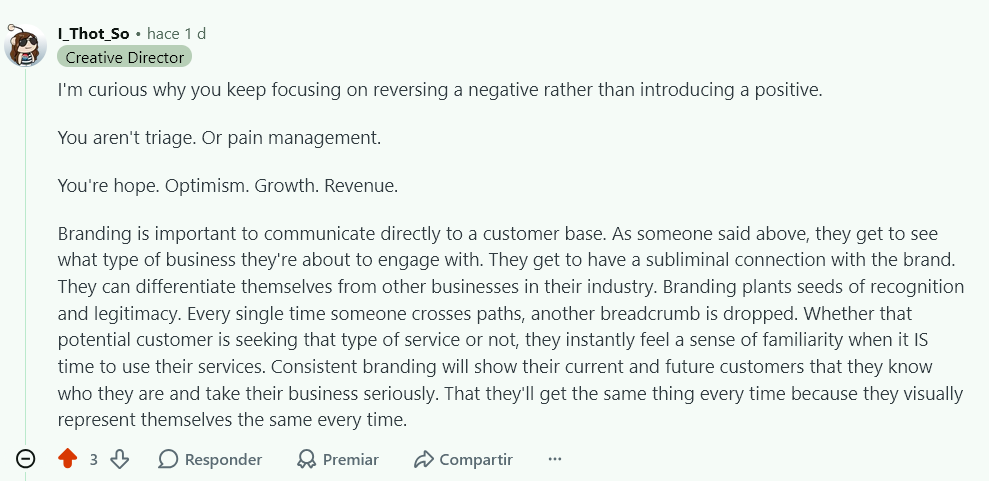
Thank you, I think these are the kind of replies I need. To add to what you said, since it’s something you mention as well, I read somewhere else that it all comes down to consistency and familiarity. People might not purchase you right now, but being consistent builds that trust and familiarity signaling that you are serious about this. Since you look the same they can expect you will deliver the same (hopefully good) every time.

This is the reply:

Sure, but in your experience how many businesses come through formal recommendations, and how many through advertising or branding?

Most mechanics, tradespeople, local shops, and service providers I’ve used came through word of mouth, online reviews, or someone simply saying “give this person a call, they’re good.”

I don’t use a grocery shop because of its branding, logo, or marketing. I use it because it’s close by and easy to get to. I’ve no loyalty to the brands in my area, Dunnes, Tesco, Lidl, Aldi, SuperValu. I bounce between them because I know I can get the spuds €1.50 cheaper in one place and something else cheaper in another.

Logos still have value, but not because they’re generating recommendations. Recommendations happen because of quality of service, quality of product, price, convenience, reputation, and customer experience. The logo simply helps people identify and recognise the business.

Take Google for example. It’s hardly what I’d call a great logo, yet it’s one of the most recommended services on the planet. How many times have you heard someone say “Google it”? That’s not because of the logo. It’s because the service became useful enough that the brand name entered everyday language.

What you mention here is one of my biggest concerns about logos, leading me to not understand clearly what value they hold. I been back and forth with this for years. It’s why I think most designers jump into providing either branding, visual identity or strategy in addition to logo design because it’s hard to measure and sell their isolated value.

I’m finally tackling those concerns with these questions and posts alike for the past two months.

So is that really a disagreement?

You can look at it from the problem side of the equation or the solution side. If the problem is poor recognition, the solution is familiarity. If the problem is inconsistency, the solution is trust. If the problem is confusion, the solution is differentiation.

I wouldn’t say it’s the same coin with different sides. I’d say it’s the same dice, different sides, and a different number of sides depending on the game you’re playing.

I think there’s a thin line when people start linking logos directly to growth or revenue. Businesses with awful logos, like Google, often do very well, while businesses with excellent logos and branding can still fail or struggle (Pan Am, Blockbuster, Enron, etc.).

Yes, logos can improve recognition, consistency, differentiation and legitimacy, but they only support growth. They don’t guarantee it. At the end of the day, the product, service, pricing, customer experience, reputation and a hundred other factors still have to do the heavy lifting.

1 Like

I think part of the reason many designers jump into branding, visual identities and strategy is because a logo on its own can be difficult to measure and sell.

And you see so often ‘logos for $25’, well simply I wouldn’t open my eyelids for €25, do I want that business, absolutely not. Because logo design could take 1 day for establishment with client. 1 day for research, 1 day for logo iterations, 1 day for narrow down, 1 day to put together presentation. I don’t do 5 days for €5 a day. Nobody does, nobody even works for €5 an hour (well I surely hope not!).

That said, I think a lot of designers also jump straight into creating a brand without really understanding the business. That’s one of the biggest problems I see with a lot of Behance-style projects. The visuals look great, but they’re often built around assumptions rather than reality.

Someone comes along and says they need a logo for a coffee truck. Most people immediately think coffee bean, coffee cup, steam, nice typeface, job done.

But that’s where the questions should start, not finish.

What kind of coffee do you sell? Premium or budget? Is it locally roasted? Fairtrade? Organic? Eco-focused? Who are your customers? Office workers? Hikers? Festival goers? Commuters? Do you sell food? Tea? Cold drinks? Is the truck parked in the same place every day or moving around? Who are your competitors? What makes people choose you over them? What do customers say about you?

The answers to those questions might lead to a very different solution.

Equally, some businesses don’t need much at all. A coffee truck with a cardboard sign saying “Coffee Here €1” might do fantastic business if it’s in the right location with decent coffee. It may never need a sophisticated logo, branding strategy or visual identity.

I suppose that’s where I keep coming back to the same point before deciding whether a logo, brand identity or marketing strategy is needed, you first need to understand the actual business problem you’re trying to solve.

1 Like

These two might be most important final takeaways for me. And in retrospective the second one it’s what initially started my original question in the post, hence the title.

I think this might be full circle :slight_smile: , I’ll be taking notes and maybe come back with specific doubts. But for now I think your insights are what I needed. Thank you.